The Silent Tax of Context Switching
Why juggling multiple tasks feels productive but actually drains your focus, and how to restructure your workday for deep, meaningful work.
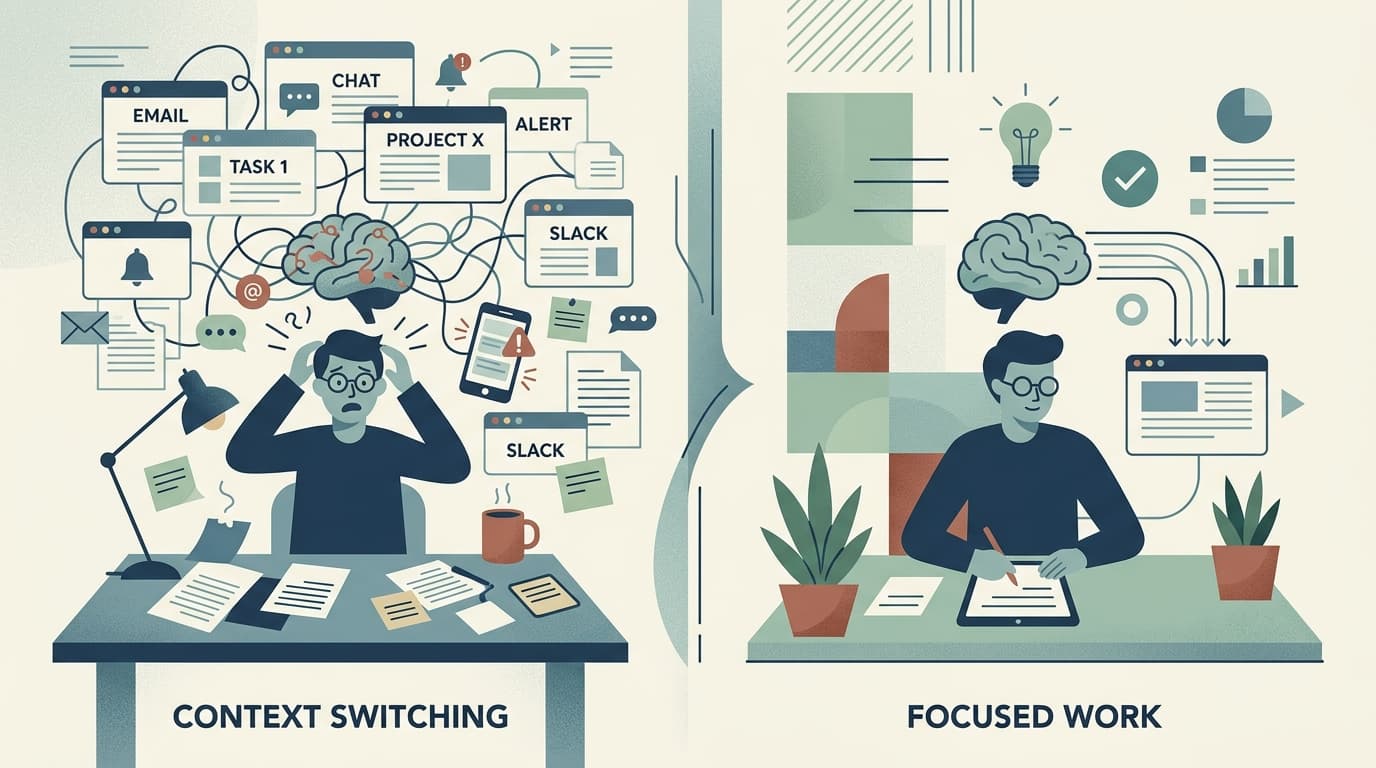
We've all had those days. You finish an eight-hour shift feeling completely exhausted, yet when you look back at what you actually accomplished, the list is frighteningly short. You answered a dozen emails, replied to Slack messages, hopped on two brief calls, and nudged a spreadsheet forward. But the real work—the deep, difficult project you meant to tackle—remains untouched.
This is the silent tax of context switching.
The myth of multitasking
The human brain is an extraordinary pattern-recognition machine, but it has a fundamental flaw: it cannot truly multitask. When you think you are multitasking, what you are actually doing is rapidly switching your attention back and forth between different contexts.
According to research from the American Psychological Association, even brief mental blocks created by shifting between tasks can cost as much as 40 percent of someone's productive time.
Every time you glance at a notification while writing a report, your brain has to load a new set of rules and contexts into its working memory. When you return to the report, it takes time—often up to 20 minutes—to reload the original context and regain your previous level of focus.